The Call of the Void: Why Your Brain Says “Jump” at the Edge
Ever stood at an overlook and had a sudden, unwanted thought of jumping? It’s called the call of the void, it’s more common than you’d think, and the research suggests it may be your brain’s safety system at work.
Have you ever stood at the edge of an overlook, nice view, solid footing, and out of nowhere a little voice in your head says, “What if I just jumped?” You step back, heart thumping, and think, “Where on earth did that come from?”
If that’s happened to you, you’re in good company. It’s happened to me, too. And it turns out there’s a name for it, and some real science behind it.
[YouTube video embed goes here — video not uploaded yet]
It has a name
This came up at our morning standup at work, when my coworker MacKenzie described this exact feeling. I thought, “Wait a minute. I’ve felt that!” Since so many of us hike along canyon rims, river ledges, and mountainsides, I went digging into the research.
The popular name is “the call of the void.” The French call it l’appel du vide. Researchers have a plainer name for it: the high place phenomenon.
It’s that sudden urge, or just the thought, of jumping when you’re up high: on a bridge, a balcony, a cliff edge, a fire tower. The key word is unwanted. You don’t want to jump. The thought just shows up, uninvited, and is usually gone in a second or two.
My own moments at the edge
It happened to me twice this past summer: once along a river gorge, and again in the Porcupine Mountains, both in Michigan’s Upper Peninsula (U.P.).
I was on a trail along a high bank, looking down, when that thought showed up. So I talked back to it: “Barry, you’re not going to do it. But if you fell, that wouldn’t be good.” And then, “Well, there are a few trees you could grab on the way down.”
I’ve had it crossing trail bridges, too, looking down at the water thinking, “Boy, I’d like to jump in there.” Honestly, it happens just about any time I’m somewhere high. Those thoughts keep me from getting too close to the edge. But on a trail, sometimes the path runs right along the drop, and you just keep moving forward.
What the science says
In 2012, psychologists at Florida State University published the first real study of this. Led by Jennifer Hames, with suicide researcher Thomas Joiner on the team, it ran in the Journal of Affective Disorders under a title I love: “An urge to jump affirms the urge to live.”
They surveyed 431 college students online about this experience, plus depression, suicidal thoughts, and something called anxiety sensitivity. The urge to jump was common. And more than half of the students who’d never had a single suicidal thought still said they’d felt it at least once.
One caveat: it was a one-time survey of college students, so it can’t prove cause and effect.
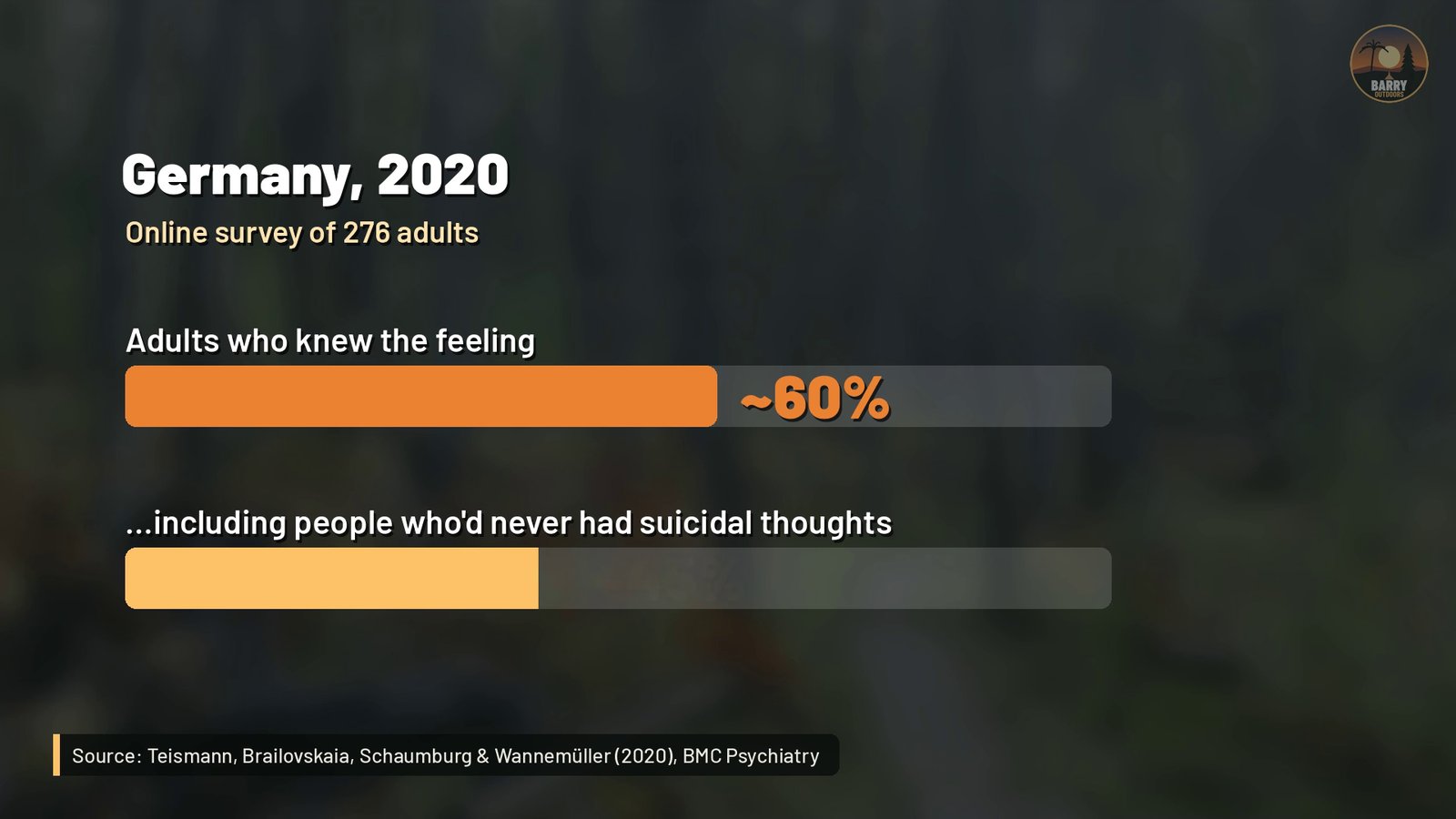
Others have tested it since. A 2020 study in Germany found that about 60 percent of adults knew the feeling, including about 45 percent of people who’d never had suicidal thoughts. And a 2025 study of adults in Iran found somewhere between 39 and 62 percent, depending on the group. So it shows up across cultures.
A misread safety signal
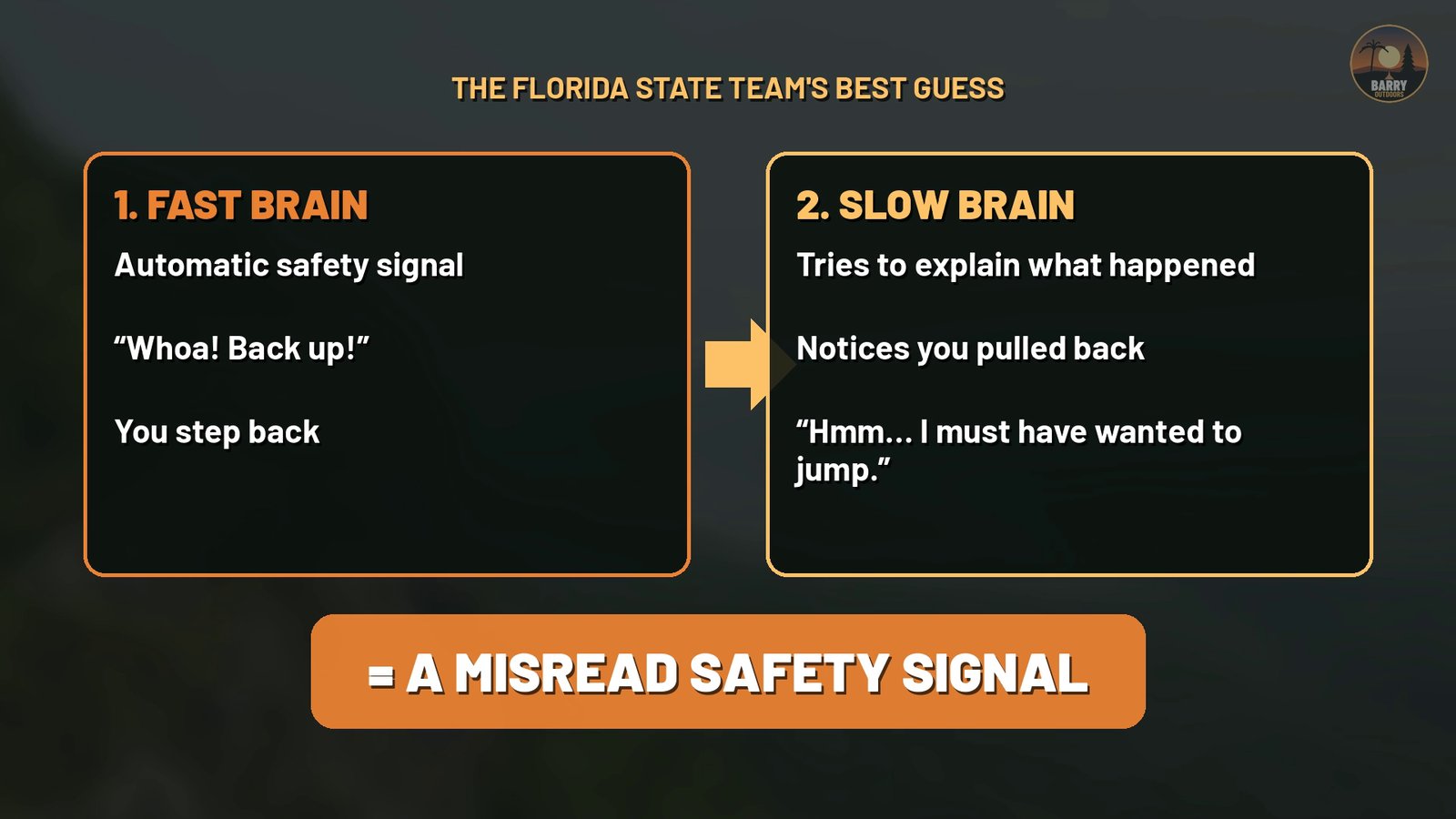
So why would a healthy brain cook that up? Here’s the Florida State team’s best guess.
Near an edge, the fast, automatic part of your brain fires off a safety signal: “Whoa! Back up! You could fall!” You step back, sometimes before you even realize it.
A split second later, the slower, thinking part of your brain notices you pulled back and fills in the blank: “Hmm… I must have wanted to jump.”
Your survival instinct did its job, and your brain put the wrong label on it. That’s why the study says the urge to jump actually affirms the urge to live.
Remember anxiety sensitivity? It’s how strongly you react to your body’s alarm signals, like a racing heart. People who scored higher reported the experience more often, which fits the safety-signal idea. To be fair, the 2025 study didn’t find that link. It suggested this may simply be one of those random intrusive thoughts.
Intrusive thoughts are close to universal. A 2014 international study of 777 university students in 13 countries, on six continents, found about 94 percent had at least one unwanted intrusive thought in the past three months. Having the thought isn’t the problem. It’s just a brain being a brain.
What it isn’t
It isn’t acrophobia, an intense, lasting fear of heights that makes people avoid ladders, balconies, or bridges. Plenty of people who feel the call of the void are perfectly comfortable up high.
And it isn’t vertigo, a physical balance problem, often from the inner ear, where you or the world around you feels like it’s spinning. If you get dizzy or things start spinning on the trail, see your doctor.
For most people, it isn’t a hidden death wish, either. That said, if these thoughts stick around, keep coming back, or come with any real wish to hurt yourself, please talk to someone. In the U.S., you can call or text 988, the Suicide & Crisis Lifeline, any time. Outside the U.S., you can find a helpline at findahelpline.com.
Flat Florida vs. the North Country Trail
Down in South Florida, where I hike the Florida Trail with the Tropical Trekkers, this just doesn’t come up. It’s flat country. The highest bank might be twenty feet, so unless you climb a fire tower or observation deck, there isn’t much of an edge to call you. Up north, on the North Country Trail and those river bluffs in the U.P., it’s a different story.
My 3 tips for edges and overlooks
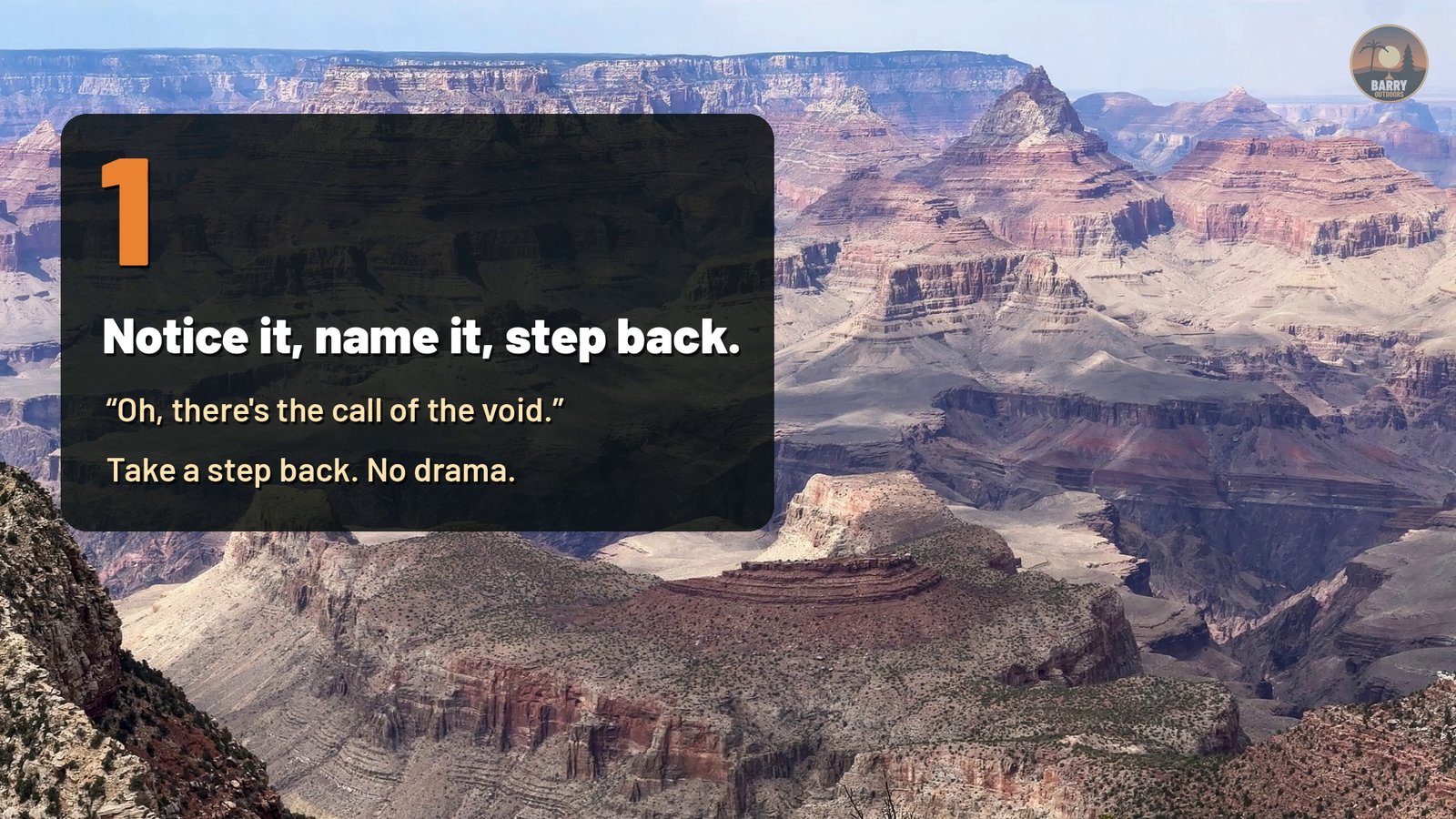
- Notice it, name it, and step back. When that thought pops up, I say to myself, “Oh, there’s the call of the void.” Then I take a step back. No drama.
- If there’s a rail, keep a hand on it. At overlooks and fire towers, a hand on the rail settles my mind, and my balance.
- Stay well back from unfenced edges. Especially when you’re tired, when it’s windy, or when the rock is wet. With two new knees, I’m extra choosy about where I put my trail shoes.
The bottom line
If you’ve felt that strange pull at the edge, you’re normal. It’s common, and it may be your brain’s safety system doing its job, then telling you about it in a really clumsy way.
So enjoy the view. Notice the thought. Smile at it. And take one step back.
Has this happened to you? Tell me where in the comments. Thanks for hiking along with me. Gail, Ginger, Cinnamon, and I will see you down the trail.
Listen to the episode
Prefer to listen? Subscribe to Barry Outdoors in your podcast app with the podcast Really Simple Syndication (RSS) feed: https://feeds.blubrry.com/feeds/barryoutdoors.xml
Watch on YouTube
Studies and sources
- Hames JL, Ribeiro JD, Smith AR, Joiner TE Jr. (2012). “An urge to jump affirms the urge to live: An empirical examination of the high place phenomenon.” Journal of Affective Disorders, 136(3), 1114–1120. https://doi.org/10.1016/j.jad.2011.10.035 (PubMed)
- Teismann T, Brailovskaia J, Schaumburg S, Wannemüller A. (2020). “High place phenomenon: prevalence and clinical correlates in two German samples.” BMC Psychiatry. https://link.springer.com/article/10.1186/s12888-020-02875-8
- Asgari Z, Naghavi A, Abbasi A, Ertle A, Wiesmann L, Teismann T. (2025). “High place phenomenon, obsessive-compulsive symptoms and suicidality.” Frontiers in Psychiatry. https://www.frontiersin.org/journals/psychiatry/articles/10.3389/fpsyt.2025.1653961/full
- Radomsky AS, et al. (2014). “Part 1 – You can run but you can’t hide: Intrusive thoughts on six continents.” Journal of Obsessive-Compulsive and Related Disorders, 3(3), 269–279. https://doi.org/10.1016/j.jocrd.2013.09.002
- Cleveland Clinic. “Acrophobia (Fear of Heights)” and “Vertigo vs. Dizziness.”
- 988 Suicide & Crisis Lifeline (U.S.): call or text 988. https://988lifeline.org
Background reading: Healthline, “Call of the Void.”
This post is for general information and isn’t medical advice.
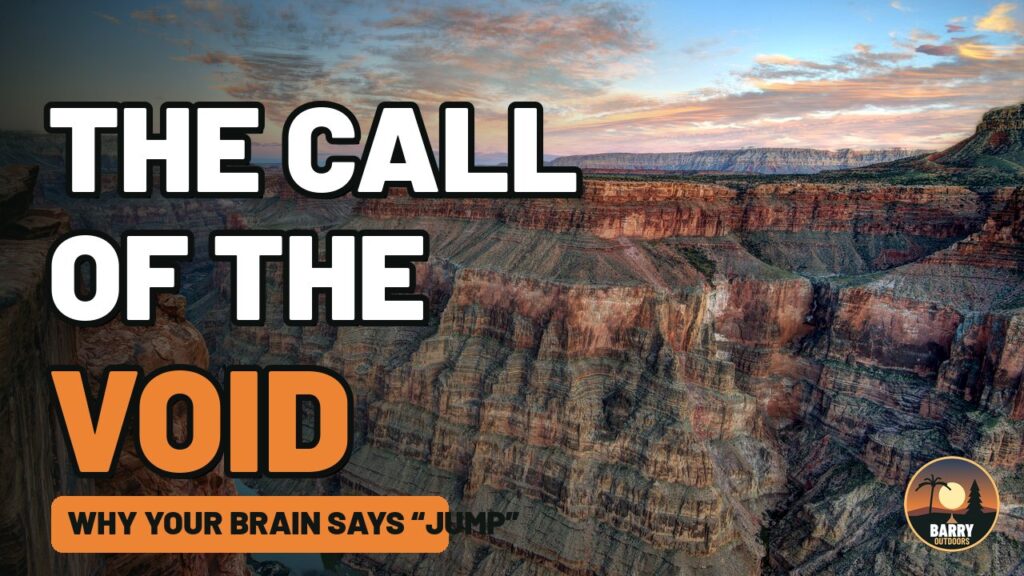
Media credits: Featured image background: “Toroweap Sunrise” by John Fowler, CC BY 2.0, via Wikimedia Commons (cropped, color-graded, text added). Tip 1 infographic background: “View from Grandview Point” by Grand Canyon National Park Service (NPS), public domain. Infographics made for Barry Outdoors; full photo and video credits will be in the YouTube video description. Narrated with an AI voice made from my own voice (Chatterbox), from a script I wrote. Music: the Barry Outdoors theme plus a quiet background bed, made with ElevenLabs AI music.