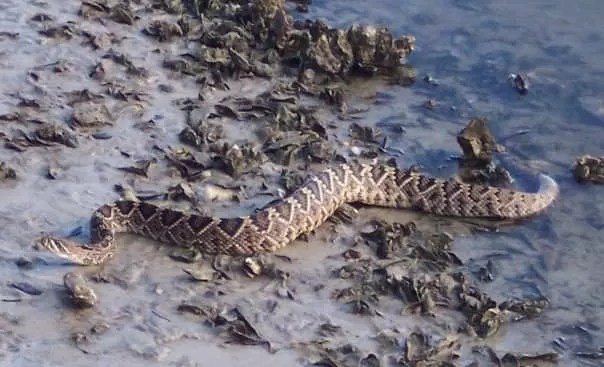
I was hiking the White Trail at Savannas Preserve State Park, one of my favorite Florida trails to do training hikes, when I heard it — a short hiss, then that unmistakable dry-leaf rattle. I didn’t think. I jumped. Four feet straight down the trail, flying without wings. When I turned around, there it was: a rattlesnake at the trail edge, maybe three feet from where I’d been walking a second earlier. This was not a pencil-thin baby. The body was as thick as my wrist — and I’m a big guy. My hiking buddy has since given me a new trail name.
They call me Rattler now. One of my trail family members christened me with the name when she heard the story.
And after the adrenaline wore off, the question I couldn’t stop turning over was this: how often does that actually happen? How lucky — or unlucky — was I? What are the real odds of a snake bite on the trail? So I did the homework. Here’s what the data says.
The raw numbers — smaller than the fear
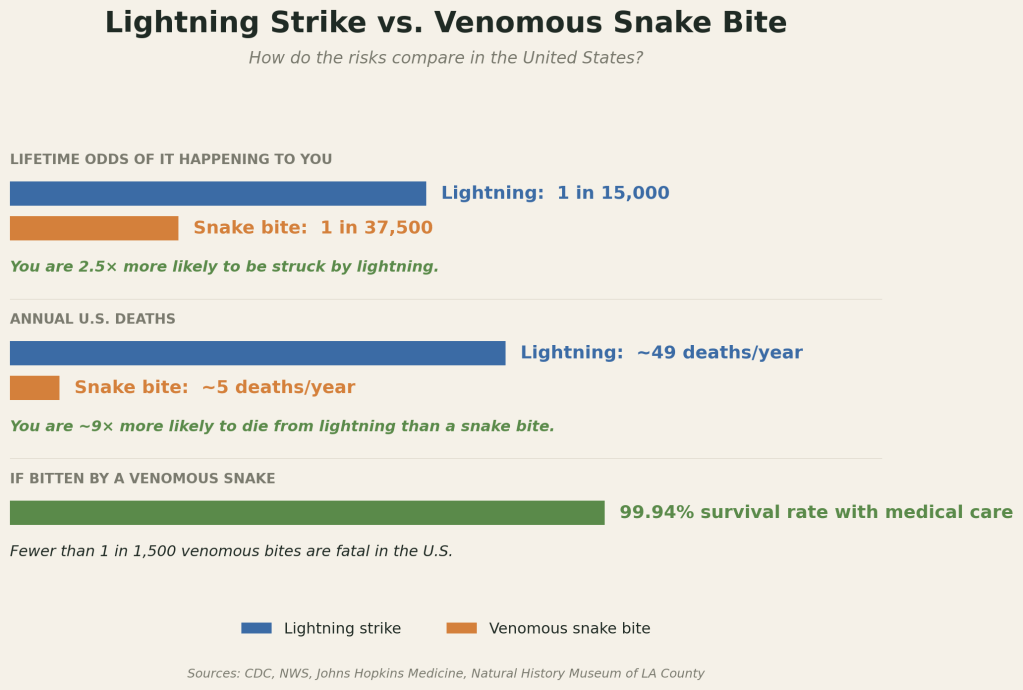
In the United States, somewhere between 7,000 and 8,000 people are bitten by a venomous snake each year. Total bites, including non-venomous species, run closer to 45,000. Of the venomous bites, about five a year end in a fatality. That’s a fatality rate of roughly 0.06% — less than 1 in 1,500.
Put that against the 75 million Americans who go hiking annually, and the risk of a venomous bite on any given hike is tiny. Your lifetime odds of a venomous snake bite sit around 1 in 37,500. Your lifetime odds of being struck by lightning? About 1 in 15,000. You are more than twice as likely to be hit by lightning as bitten by a venomous snake, and about nine times more likely to die from a lightning strike than from a bite. The Natural History Museum of Los Angeles County points out that rattlesnakes kill fewer Americans each year than ladders, falling televisions, or domestic dogs.
Which — if I’m being honest — doesn’t fully square with how my heart rate felt at the trail edge that afternoon. But the numbers are the numbers.
Who actually gets bitten — the uncomfortable profile
Here’s where the data gets inconvenient. Multiple epidemiological studies of U.S. bite victims land on the same profile: the typical victim is a young male, often between 17 and 27, bitten on the hand or arm. In some datasets up to 98% of recorded victims are male. Alcohol is involved in a significant share of cases — some studies put it over half.
Emergency physicians sometimes refer to this as the “T’s” of snakebite — Testosterone, Tattoos, Teeth (missing), and Tequila. It sounds like a joke. It’s not. It reflects a real pattern: a large share of serious bites happen when somebody deliberately picks up, handles, or tries to move a snake. Bites from a snake the hiker never saw — the scenario that nearly happened to me — are a minority.
The American Hiking Society and Johns Hopkins both underline the same point: if you don’t touch the snake, your risk drops dramatically. When my rattler flared up, every instinct said: “move away.” That instinct is, statistically speaking, the most important piece of gear you carry.
The trail-specific risk: where Rattler found me
Hikers aren’t exempt, though. Snakes use trails the same way we do — they’re open, sun-warmed corridors through dense vegetation. Rocky outcrops, leaf-covered trail edges, blowdowns across the path, and stream crossings are classic encounter zones. A snake isn’t hunting you. It’s hunting rodents in the exact same habitat we love to walk through.
My encounter checks every box. Savannas Preserve is classic Florida scrub and wet prairie — warm, rodent-rich, full of palmetto edges. The snake was tucked right at the trail’s lip, exactly where research says bites most commonly originate: a snake resting in vegetation a step off the tread, invisible until you’re on top of it.
Timing matters too. Most U.S. bites happen between March and October, peaking in late summer. Dawn, dusk, and the first warm days after a cool spell are the higher-risk windows. In the U.S., roughly 70% of venomous bites involve a rattlesnake, and the eastern and western diamondbacks account for up to 95% of fatalities. Geographically, North Carolina leads in bites per capita (about 19 per 100,000). The Southeast and Southwest dominate the statistics, which, as a Florida hiker, is exactly the environment I was in.
Five rules that keep the odds in your favor
What saved me on the White Trail wasn’t gear — it was reflex and the fact that I was doing the right things by default. These are the five habits that do almost all the work.
First, stay on the trail. Snakes are camouflaged against leaf litter and palmetto shadow, but they stand out against a worn tread. You’ll see them before you step on them. Step off, and you lose that advantage.
Second, wear ankle-length boots and long, loose pants. Most defensive strikes land below the knee, and fabric layers genuinely reduce fang penetration. In snake country, skip the trail runners.
Third, use trekking poles and actually use them. Probe ahead in tall grass, around blowdowns, and at stream crossings. A snake will strike the pole, not you. I was using poles on this hike, and I will be using them on my next hike in the Savanna Preserve.
Fourth, look before you sit, reach, or step over. The classic bite happens when someone sits on a log without checking the far side, reaches into a rock crevice, or steps over a downed tree into the coiled snake behind it.
Fifth, if you see a snake, give it six feet and walk around. Do not try to move it. Do not close in for a better photo. Do not kill it. Nearly every serious bite involves someone who chose to close the distance. When my rattler announced itself, the correct response was exactly what I did by accident: go the other way, fast.
If it happens anyway: what to do, what NOT to do
Forget the old Western playbook. Do not cut the wound. Do not suck out the venom — you’ll just transfer mouth bacteria into the bite. Do not apply a tourniquet — it concentrates venom and can cost you a limb. Do not ice it. Do not take ibuprofen or aspirin (they interfere with clotting, and many snake venoms already wreck clotting). Do not drink alcohol.
Do this instead: get the victim calm and still — a racing heart moves venom faster. Remove rings, watches, bracelets, and tight clothing before the limb swells. Wash the bite with soap and water. Use a pen to mark the edge of the swelling and write the time next to the mark — then re-mark every 20 to 30 minutes. That timeline is gold when you hit the ER, because it tells the physician how fast the envenomation is progressing. Then get to medical help — steady pace, not a sprint. With modern emergency care, survival rates sit around 99.98%.
The takeaway from a newly minted “Rattler”
The fear is out of proportion to the real risk. A hiker in reasonable boots, on the trail, with hands to themselves, sits in the safest cohort of an already tiny risk pool. The statistics are dominated by people who chose to engage with the snake, not by the ones who heard a rattle and launched four feet forward like their boots had springs.
I got lucky on this hike. Or, more accurately, I got lucky, and I did the right things by reflex. The snake did its job — it warned me, gave me every chance to leave, and I took it. That’s the deal snakes offer, and if you respect it, the trail stays yours. If you prefer to watch rather than read, I will be making a companion video walking through the full story, the stats, and the field protocol — watch for a link in the sidebar. Subscribe if this was useful, and drop a comment with your own trail snake encounter. I know I’m not the only one out here with a new nickname.


 Outdoors With Barry
Leave a comment